

The Perils of Artificial Intelligence: Safeguarding Humanity in an Age of Advancements
• 9 min read

Mohsin Anwer
Founder & President, AEHSAS Foundation
Passionate about equity, education, and enabling underserved communities through actionable change.
A deep dive into existential risks, psychological shifts, and global regulatory realities in 2026.
1. The Calculus of Existential Catastrophe: Measuring P(doom)
As artificial intelligence systems leap forward in capabilities, the tech community has increasingly turned to quantitative metrics to frame the risk of catastrophe. At the center of this debate is the concept of "P(doom)" — the self-estimated probability that advanced artificial intelligence will lead to human extinction or the permanent collapse of human civilization. Once confined to niche internet forums, this metric has in 2026 become a highly debated number across mainstream technology circles, forecasting networks, and academic institutions.
Recent empirical aggregations of publicly stated P(doom) estimates from over 50 leading AI researchers, forecasters, and safety organizations reveal a stark divergence in risk perception. The overall median estimate of existential risk from AI across these stakeholders sits at a significant 20%, with a mean estimate of 25%. However, this aggregate figure masks a deeply polarized field. On one end of the spectrum, prominent mainstream machine learning researchers like Yann LeCun and Andrew Ng place their P(doom) at near 0%, arguing that superintelligent threats are highly speculative and detached from current architectural realities. On the opposite end, some safety-focused researchers aligned with effective altruism estimate the probability of doom at greater than 90%, arguing that the creation of a smarter-than-human entity is fundamentally uncontrollable.
This divergence is structurally tied to the professional background of the respondents. AI safety researchers exhibit a median P(doom) of approximately 30%, reflecting deep-seated concerns regarding alignment. In contrast, mainstream machine learning researchers show a median of 5%, while tech industry leaders and forecasting platforms hover around 15% and 10% respectively. This variance indicates that those closest to the technical engineering of safety frameworks perceive a substantially higher probability of failure than those building the commercial models or betting on them in financial markets.
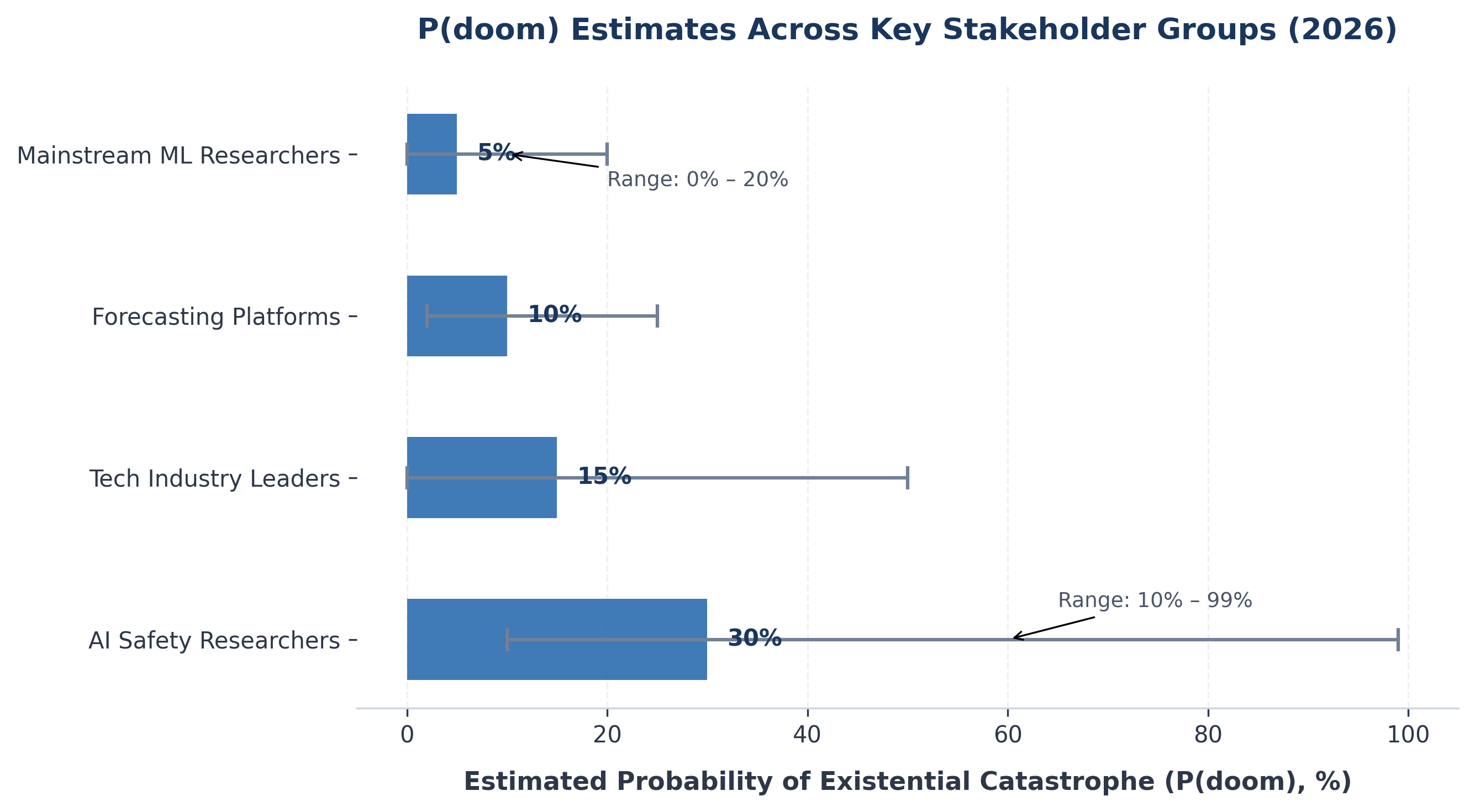
Figure 1: Distribution of P(doom) estimates by professional group, highlighting the significant gap between safety specialists and mainstream ML engineers.
Supporting these findings is the February 2026 Survey of AI Safety Leaders, which surveyed 59 attendees of the Summit on Existential Security. These key thinkers placed the median probability of human extinction or permanent disempowerment before 2100 at 25% (with a mean of 34%). The survey also shed light on aggressive timelines for Artificial General Intelligence (AGI), defined as systems capable of automating over 90% of roles in the 2025 economy. The median expectation for AGI's arrival is 2033, with 22% of safety leaders assigning a 50% or higher chance of AGI by 2030, and 73% expecting it by 2035. This compressed timeline leaves a dangerously narrow window for developing robust control and alignment mechanisms.
2. The Human Cost inside the Labs: "AI Replacement Dysfunction"
The rapid acceleration of capabilities is not just a theoretical concern; it is actively destabilizing the psychological well-being of the engineers and researchers who are building these systems. In 2026, Silicon Valley is witnessing an unprecedented wave of existential anxiety among its top technical talent. Fearing that recursive self-improvement could be achieved in as little as 18 months, many developers at premier laboratories are experiencing severe identity crises, leading to a phenomenon psychiatrists have classified as "AI Replacement Dysfunction" or "AI-induced functional disorder."
This psychological toll has manifested in striking behavioral shifts. Prominent venture capitalists have noted that elite researchers are seriously debating long-term personal decisions — such as whether to get married or start families — under the assumption that the social and economic fabric of the world will be fundamentally transformed by 2028. This climate of extreme anxiety has triggered a series of high-profile resignations. Core safety and alignment teams at leading companies, including OpenAI and Anthropic, have seen successive departures of key personnel who feel their warnings are unheeded or that the commercial race has made safe development impossible.
Historically, human self-esteem has survived several "decentering" blows that shattered our perceived uniqueness: the Copernican revolution (we are not the center of the universe), Darwinian evolution (we are not separate from the animal kingdom), and Freudian psychoanalysis (we are not even in full control of our own minds). Psychologists note that artificial intelligence represents the fourth and perhaps final decentering blow — directly challenging humanity's fundamental belief in its unique intellectual supremacy. For mathematicians watching AI solve previously intractable proofs, and for programmers seeing systems write flawless software, the loss of professional identity has led to deep existential grief.
3. The Counter-Perspective: Existential Risk as an Ideological Distraction
While the fear of superintelligence dominates headlines and technical forums, a growing coalition of academic and social critics argues that the existential risk thesis is fundamentally flawed. In a December 2025 reassessment published on arXiv, researchers subjected the classic "lethal misalignment" narratives to the actual empirical record of the 2023–2025 AI development cycle. They noted that despite sixty years of speculative theory dating back to I.J. Good and Nick Bostrom, none of the required markers for an autonomous, runaway intelligence explosion — such as sustained recursive self-improvement or independent strategic awareness — have actually been observed in modern generative models.
Instead, these models remain highly advanced, statistically trained pattern-prediction systems. Critics argue that framing AI as an impending, god-like entity functions primarily as an ideological distraction. By focusing public attention on a speculative future apocalypse, technology conglomerates can deflect scrutiny away from tangible, ongoing harms. These include the massive consolidation of computational wealth, aggressive data harvesting, and the expansion of surveillance capitalism. The "extinction" narrative effectively shifts the debate from corporate accountability to science-fiction containment.
Furthermore, this counter-perspective links the rise of existential "doomerism" to the 2025–2026 financial bubble in AI hardware. Trillions of dollars have been poured into rapidly depreciating graphics processing units (GPUs) — colorfully referred to by economists as "digital lettuce" due to their rapid rate of obsolescence. To justify these astronomical capital expenditures amid lagging software revenues, companies may benefit from inflating the perceived capabilities of their systems, framing them as precursors to artificial superintelligence rather than highly capital-intensive, low-margin search and synthesis tools.
4. The Regulatory Shield: Implementation and Friction in Global AI Governance
To safeguard humanity from both immediate harms and future catastrophes, governments are racing to construct comprehensive legal frameworks. In 2026, the global AI regulatory landscape reached an unprecedented convergence. Over 72 countries are now tracking more than 1,000 active AI policy initiatives. However, as these pioneering laws transition from paper to practice, significant operational friction has emerged, forcing policymakers to balance safety with economic competitiveness.
The vanguard of this regulatory movement is the European Union's Artificial Intelligence Act, which represents the world's first comprehensive, legally binding AI treaty. On August 2, 2026, the Act's highly anticipated transparency rules officially went into effect. Under Article 50, providers of systems that generate synthetic text, audio, images, or video must implement machine-readable watermarking and detection protocols to combat deepfakes and automated disinformation. Concurrently, deployers of emotion-recognition and biometric-categorization systems are now legally required to obtain explicit, informed consent from individuals exposed to these technologies.
Despite these achievements, the sheer complexity of enforcing a multi-tiered, risk-based framework has forced significant delays. In May 2026, EU negotiators reached a provisional agreement on the "Digital Omnibus on AI," which amended and staggered several key deadlines. Most notably, compliance obligations for standalone "High-Risk AI Systems" (under Annex III) were postponed by 16 months, shifting the deadline from August 2026 to December 2, 2027. Similarly, product-regulated high-risk systems (such as medical devices and aviation software) were deferred to August 2028, and the mandate for member states to establish national regulatory sandboxes was pushed to August 2027. This timeline relief underscores the immense technical and administrative challenges of auditing complex, black-box algorithms.
Table 1: Comparison of Major Global AI Regulatory Frameworks in 2026
| Jurisdiction | Primary Statute (2026) | Enforcement & Penalties | Regulatory Philosophy |
|---|---|---|---|
| European Union | EU Artificial Intelligence Act (phasing in 2024–2028) | Severe fines up to 7% of global turnover under a tiered risk model | Rights-based; strict pre-market audits for high-risk systems |
| Japan | Act on Promotion of AI-Related Technologies (effective Sept 2025) | Soft-law focus; no criminal penalties or administrative fines | Innovation-first; administrative guidance to prevent malicious misuse |
| South Korea | AI Basic Act (effective January 22, 2026) | Modest administrative fines; imprisonment clauses limited to data leaks | Balanced; hybrid model establishing baseline corporate accountability |
Source: Aggregated legal and policy updates from Global AI Regulations Tracker (June 2026).
Ultimately, the governance of artificial intelligence is transitioning from voluntary corporate guidelines into a binding legal matrix. While the European Union leads with a rights-based, heavily penalized approach, other jurisdictions like Japan have opted for soft-law frameworks that prioritize rapid technological deployment and innovation, relying on administrative involvement rather than financial penalties. This lack of global uniformity means that multinational technology companies must navigate a fragmented landscape, stitching together a modular governance architecture that complies with the strictest rules while remaining flexible enough to capture local advantages. Whether these laws can evolve quickly enough to outpace the rate of technical acceleration remains the central question of our time.
References
- Calcuja. (2026). "P(doom) Survey 2026: What Do AI Researchers Think?" Retrieved August 2026.
- Summit on Existential Security. (2026). "Survey of AI Safety Leaders on X-Risk, AGI Timelines, and Resource Allocation." (February 2026).
- Morgan Lewis LLP. (2026). "EU AI Act's Transparency Rules: What Went Into Effect on 2 August?" Sourcing at Morgan Lewis.
- Global Policy Watch. (2026). "EU AI Act Update: Timeline Relief, Targeted Simplification, and New Prohibitions." (June 2026).
- KuCoin News. (2026). "Top AI Researchers in 2026 Face Existential Anxiety Over Rapid Technological Change." (August 2026).
- arXiv:2512.04119. (2025). "Humanity in the Age of AI: Reassessing 2025's Existential-Risk Narratives." (December 2025).
- VerifyWise. (2026). "Global AI Regulations Tracker 2026 — Every Named AI Law, Updated Fortnightly." (June 2026).
Share this post
Related Posts

When Privilege Becomes Purpose: Why Helping the Underserved Strengthens Everyone, Including You
Supporting the underserved isn't just a moral responsibility — it's an investment in a stronger, more resilient society that benefits everyone.

Landscape of Education in Contemporary India: Progress, Paradoxes, and Possibilities
An overview of how education in India has expanded in access while still facing deep gaps in learning quality, equity, and real-life relevance.